Garden Irrigation Timing and Depth for California Yards
California yards can move from coastal fog to inland heat, and a watering routine that works in one bed may leave another parched or waterlogged. The useful question is not simply how often to irrigate: it is when the root zone needs water and whether your system wets that zone without runoff. Here’s how to assess both and adjust irrigation to your soil, plants, and season.
Why irrigation timing and depth work together
A watering schedule is only useful if it puts moisture where plants can use it. Watering too lightly may wet the surface while leaving much of the root zone dry. Watering for too long in one stretch can send water past roots or across the soil surface, especially where the ground is compacted, sloped, or slow to absorb moisture.
Timing matters because soil and plants do not lose moisture at the same rate throughout the day or season. Sun, wind, temperature, shade, plant size, and soil texture all influence how quickly a bed dries. A timer can repeat an interval, but it cannot sense those changes unless someone checks the garden and adjusts it.
Think of irrigation as a cycle of observation and response:
- Check whether the soil near the active roots is drying, rather than relying only on a calendar.
- Apply water in a way that allows it to soak in.
- Check whether the wetted area reaches the root zone.
- Adjust the next watering based on what you find.
The aim is not to keep all garden soil constantly damp. Many plants need a balance between available moisture and air in the soil. Waterlogged ground can deprive roots of oxygen and encourage root problems, while very dry soil can make it difficult for roots to take up enough water. The right balance depends on the plant and site.
A surface that looks dry does not always mean roots are dry. The reverse can also happen: a damp-looking surface may hide a dry root zone below. This is why inspecting soil beneath the surface is more reliable than making decisions from appearance alone. A quick check can also show whether water is reaching only part of a bed or spreading unevenly from a sprinkler or drip line.
California’s varied conditions make a single statewide irrigation calendar a poor fit for many yards. A shaded coastal bed, a sunny inland vegetable patch, and a container on a windy balcony can dry at very different rates. Even neighboring areas may have different exposure, soil, and plant cover. For a wider look at local differences, see Managing Garden Irrigation Across Dry California Summers and Watering California Gardens Through Long, Rainless Summer Months.
Read your soil before setting a schedule
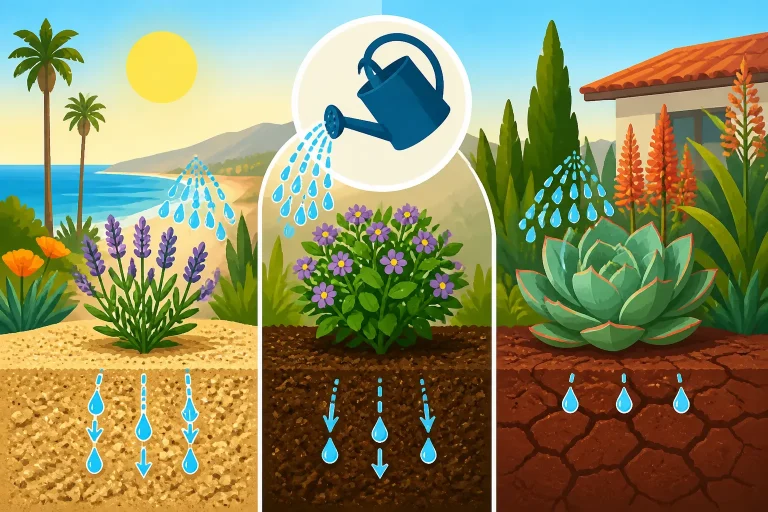
Soil texture affects how quickly water enters, how far it spreads, and how long moisture remains available to roots. The same sprinkler run or drip cycle can produce different results in sand, loam, and heavy clay. Rather than copying a neighbor’s schedule, check how your own soil responds.
| Soil condition | What to watch for | A practical irrigation response |
|---|---|---|
| Coarse, sandy soil | Water may soak in readily but pass through the root area quickly; the surface can dry fast | Check below the surface often enough to catch drying before plants show persistent stress; use irrigation that wets the root area without sending water below it |
| Loamy soil | Water often moves and drains at a more moderate pace, but structure and compaction still matter | Use a soil check to confirm that moisture is reaching the active roots; adjust for shade, slope, and plant demand |
| Heavy clay soil | Water may enter slowly, pool, or run off before it reaches deeper roots | Apply water in shorter pulses with pauses for soaking, then check whether it has moved into the root zone |
| Compacted or crusted soil | Water may pond or travel sideways instead of moving down | Slow the application, look for the source of compaction, and check moisture at several spots |
| Mulched soil | The surface may look dry or feel different from bare ground, while soil below stays moist longer | Move mulch aside to check the actual soil before irrigating |
These are tendencies, not guarantees. A sandy-looking bed can have compacted layers beneath it. Clay can be improved or disturbed in ways that change infiltration. Raised beds, imported soil, buried construction debris, and changes in slope can create sharply different conditions within a small garden.
For a more detailed comparison of textures and watering approaches, read Matching California Garden Watering to Sand, Loam, and Heavy Clay. If your main issue is slow infiltration or runoff, How California Clay Soils Affect Irrigation Depth and Runoff offers a closer look. Sandy sites need a different kind of attention; Watering Sandy California Soils: Frequency vs Moisture Limits explains why fast drainage does not mean roots should be kept continuously wet.
Check moisture where roots are active
A useful soil check is simple: move aside mulch or loose surface material, then feel soil at more than one depth in the area where roots are growing. A hand trowel or soil probe can help you inspect below the surface without digging up a plant. Compare the surface with the soil lower down. If the surface is dry but soil near the roots is still moist, immediate watering may not be needed. If the root area is dry, irrigation may be due even if the bed looks green.
Check more than one location in a bed. Soil near a plant can be wetter than soil between plants, and the area beneath an emitter may be moist while the edge of a bed remains dry. A sprinkler can leave dry pockets behind obstacles or near the edge of its reach. Sampling more than one spot helps reveal these uneven patterns.
Do not rely on a single test forever. Conditions change as plants grow, roots spread, mulch settles, and weather shifts. Treat each check as information about the current bed, not a permanent rule for the whole garden.
Look for runoff and water movement
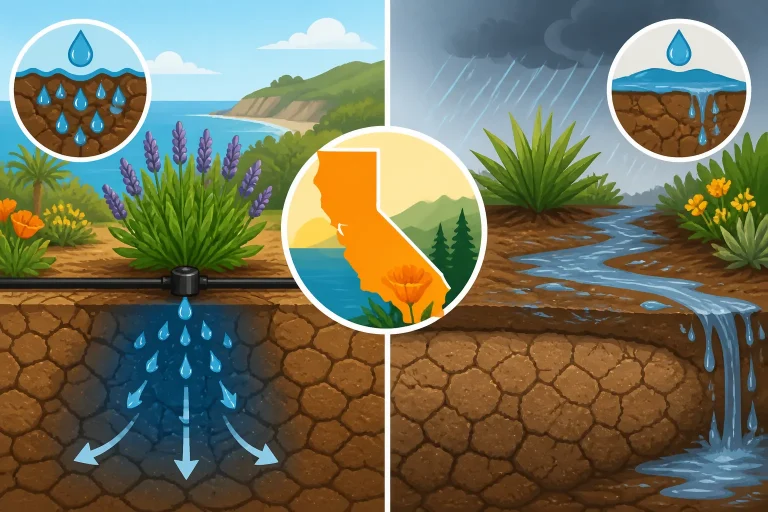
When water begins to pool or travel across the surface, it is not soaking in at the rate it is being applied. That is a cue to slow down, pause, or divide an irrigation cycle so the soil can absorb water between applications. On a slope, runoff may carry water away from the plants that need it. In a flat bed, pooling may indicate slow infiltration, compaction, or an emitter that is delivering water faster than nearby soil can absorb it.
After watering, check the soil near the roots and at the edges of the wetted area. If the center is saturated while nearby roots remain dry, changing the placement or number of delivery points may matter more than extending the same watering cycle. If moisture has moved well below the root area, the application may be longer than the site needs.
Choose a time that matches weather and plant needs
There is no single clock time that suits every plant and every California yard. A sensible time is one that lets water reach the soil and roots, limits avoidable losses, and fits the needs of the plants and irrigation system. Weather, wind, slope, and equipment all affect the result.
Watering during calmer, cooler parts of the day often helps limit evaporation and reduces the chance that wind will scatter water away from the target. But the clock is not a substitute for checking the garden. If plants are stressed and the soil near the roots is dry, address the problem rather than waiting for an ideal time. If the soil is already wet, adding more water simply because a timer is set to run can cause other problems.
Morning and evening can both be practical in different situations, but consider the whole setup. A sprinkler that throws water into gusty wind may waste water at any hour. A drip system may place water directly at the soil, making wind less influential. Dense foliage, crowded plantings, and a site that stays damp can make prolonged wetness on leaves a concern. Avoid treating a time-of-day rule as more important than the actual soil condition and the plants’ needs. See Morning vs. Evening Watering for Heat-Stressed California Plants for more on this trade-off.
Respond to heat, wind, and exposure
A sunny bed in an exposed inland location may dry faster than a sheltered bed in shade. Wind can increase moisture loss and distort sprinkler coverage. Heat can raise water demand, but a hot afternoon does not automatically mean a plant needs another irrigation cycle; check the soil first. Some plants wilt briefly during heat even when soil moisture is adequate, so confirm the root-zone condition before responding with more water.
During a hot spell, inspect vulnerable areas more frequently rather than turning every zone up equally. Containers, newly planted areas, shallow-rooted crops, and beds against hot walls may need closer attention than established plants in cooler, mulched ground. A shaded perennial bed and a full-sun vegetable bed may share a timer but not the same water needs.
If you see water running off, adding more runtime is unlikely to solve the underlying issue. A slower application, a pause between cycles, or a change in emitter placement may help water soak in more effectively. In a windy site, adjust sprinkler direction or use a delivery method that better targets the soil.
Use rainfall as information, not an automatic reset
Rain can reduce irrigation needs, but a brief shower does not necessarily wet the root zone. Leaves and mulch may be damp while the soil underneath remains dry. Conversely, a longer or heavier rain may leave the bed moist after the surface begins to dry. Check the soil rather than assuming that rain has either fully replaced irrigation or made no difference.
The same applies after a change in weather. A run of cool, cloudy conditions may slow drying; a return to warm, breezy weather may increase it. If your timer operates without regard to conditions, review its settings after meaningful weather changes and check the soil before the next scheduled watering.
Deliver water into the root zone
“Irrigate deeply” is not a fixed run time. It means that water reaches the soil volume where a plant’s active roots can use it, rather than repeatedly wetting only the surface. The depth and spread of that zone vary with plant type, age, soil, and growing conditions. A newly planted shrub, a lawn, a mature tree, and a shallow container do not have identical root patterns.
To see what your irrigation system is actually doing, check the soil after it runs. Look beneath the surface near the plant and away from the immediate point where water is delivered. If the soil is wet only right below a drip emitter, roots outside that small area may remain dry. If the moisture has passed below the active root area, a longer cycle may be wasteful.
Sprinklers
Sprinklers cover broad areas, but coverage can vary with pressure, head alignment, wind, plant height, and obstacles. Walk the area while the system runs, if practical, and look for heads that are blocked, tilted, leaking, or watering pavement. Check whether the spray reaches the beds or lawn evenly. A zone that includes plants with different needs may be difficult to manage with a single setting.
For lawn watering, look for both dry patches and overly wet areas. A lawn’s color alone does not explain the cause of a problem: compaction, uneven coverage, disease, pests, or other stresses can resemble drought. Check the soil and the sprinkler pattern before increasing run time across the whole lawn. If only a section is dry, address the coverage issue there rather than soaking healthy areas more.
Drip irrigation
Drip systems deliver water near selected plants, but the wetted pattern depends on the emitter, soil, spacing, pressure, and the time water is applied. In coarse soil, moisture may spread less sideways than it does in finer soil. In clay, water can spread differently and may move slowly. An emitter that works well for one plant or soil may not adequately wet another.
Check below and beside each emitter, not just directly at its outlet. Make sure emitters have not shifted, clogged, or become buried under debris. Look for leaks, loose tubing, and dry patches between delivery points. As plants grow, their root areas expand; irrigation placement that suited a small start may no longer cover the larger plant’s needs.
Drip irrigation is not automatically water-efficient in every setup. Poor placement can leave roots dry while the system runs. A leak can saturate a small spot while the rest of the bed gets too little. A timer can create a misleading sense of precision if its settings are not checked against soil moisture.
Hand watering
Hand watering is useful for targeted care, new plantings, containers, and small beds. Its main drawback is inconsistency: it is easy to wet the surface quickly and move on before water has soaked through the root area. Apply water slowly enough to let it enter the soil, then check whether it reached the intended depth. If water starts running off, pause and allow it to soak in before continuing.
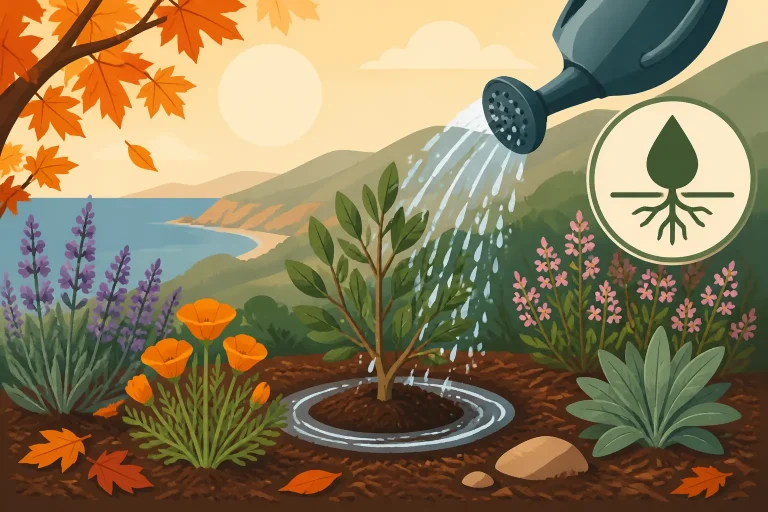
Direct water toward the soil rather than routinely wetting foliage. This can reduce unnecessary splashing and helps target the roots. Avoid forceful streams that displace soil, expose roots, or damage tender plants. For newly planted plants, water the surrounding root area too, not only the original root ball, while avoiding a persistently saturated planting hole.
Cycle and soak
When soil absorbs water slowly or a slope sheds it, a continuous application may create runoff before enough moisture reaches the roots. Breaking irrigation into pulses with pauses between them can give water time to enter the soil. The pause is not a fixed duration; it depends on how fast the site absorbs water and whether runoff has stopped. Check the soil and adjust rather than relying on a universal timer setting.
This approach is especially worth considering on compacted ground, heavy clay, and slopes, but it is not a cure for every irrigation problem. If a sprinkler is aimed at pavement or a drip emitter is misplaced, changing the cycle pattern will not correct the coverage. Find the cause, then use pauses where they help infiltration.
Match irrigation to the plant and growing space
Plants differ in root depth, leaf area, growth stage, and tolerance of dry or wet soil. A mature shrub with established roots is not managed the same way as a recently planted transplant. A vegetable bed in active growth may have different needs from a dormant or declining planting. Grouping plants with similar water needs makes it easier to set irrigation zones that match the landscape.
Established plants and new plantings
Established plants often have roots that explore a larger area than the original planting hole. Watering only at the trunk or stem may not reach enough of that root system. For shrubs and trees, consider the spread of the canopy and the surrounding root zone, while avoiding the assumption that every mature plant needs the same watering pattern.
New plantings need attention because their roots may not yet have spread into surrounding soil. Check both the original root ball and the soil around it. The root ball can dry faster or hold moisture differently than the surrounding ground, especially when planting media and native soil differ. Water should reach the root ball without leaving it continuously saturated.
As roots establish and spread, irrigation placement and frequency may need to change. Do not keep a newly planted plant on its original care routine indefinitely. Observe new growth and soil moisture, then adjust gradually in response to the actual conditions.
Vegetables, lawns, and ornamental beds
Vegetable beds can contain plants at different growth stages and with different root patterns. A seedling’s root zone is small, while a larger plant can draw moisture from a broader area. If a bed includes both, check whether one watering approach is leaving part of the planting too wet or too dry. Mulch can reduce surface drying, but it does not remove the need to check the soil beneath it.
Lawns have a broad network of roots close to the soil surface compared with many established shrubs and trees, and sprinkler coverage is central to their care. If an area browns or wilts, inspect the soil and irrigation distribution before assuming the whole lawn needs more water. The University of California Statewide Integrated Pest Management Program advises: Water lawns deeply the day before you fertilize. After applying fertilizer, the same program advises gardeners to water just enough to wash fertilizer off the grass blades and into the soil.
Ornamental beds are often a mix of plant types. If plants with very different moisture needs share a zone, the system may overwater some while under-watering others. Where feasible, group plants according to similar water needs and exposure. If re-zoning is not practical, use local checks and hand watering to address the specific plants or patches that need attention rather than repeatedly soaking the entire area.
Containers and raised beds
Containers and raised beds can dry faster than in-ground soil because they have less soil volume or greater exposure to sun and wind. Yet they can also become waterlogged if drainage is poor or irrigation is excessive. Check the growing medium below the surface and inspect drainage. A dry top layer alone is not enough to determine whether a container needs water.
The pot’s material, size, plant growth, and location all affect how quickly it loses moisture. A container beside a hot wall may dry differently from one in a sheltered spot. A plant that has filled its container with roots may use water more quickly than it did when small. Check containers individually instead of assuming that all pots on a patio need the same treatment.
Raised beds also vary. A bed filled with coarse material may drain quickly; a bed with dense soil may absorb water slowly. If a raised bed has different layers or soil mixtures, moisture may not spread evenly. Check several points and adjust delivery so water reaches the root area without pooling or running down the sides.
For soil-specific approaches, Checking Topsoil Moisture Before Midsummer Yard Irrigation can help reinforce the habit of checking before watering. Container gardeners can also use Summer Container Watering Schedules for California Heat as a related resource, while remembering that local checks matter more than adopting a fixed schedule unchanged.
Adjust irrigation as California seasons change
A timer that suited a mild period may not fit a hot, dry stretch, and a setting used through dry weather may be unnecessary after useful rain. Seasonal adjustment is not about switching on or off on a fixed date. It is about noticing changes in soil moisture, weather, plant growth, and rainfall, then reviewing the schedule.
During warm, dry weather
When rain is absent and the weather is hot, inspect beds and containers more closely, especially those exposed to sun and wind. Check below the surface rather than relying on wilt or leaf color alone. If the soil near active roots is drying, irrigate in a way that reaches that area. If it remains moist, do not add water just because the season is warm.
Mulch can slow moisture loss from the soil surface, but it can also make a quick visual check less informative. Move it aside before checking. Keep mulch from hiding irrigation leaks, covering plant crowns, or preventing you from noticing pooling. If water fails to reach the soil because mulch or dense growth has shifted the flow, adjust the delivery rather than extending the timer blindly.
When rain returns
When seasonal rain begins, review automatic settings and check soil before a scheduled cycle. Rainfall can be uneven across a yard, and one bed may receive runoff while a sheltered bed stays dry. A rain sensor, if present, may not reflect moisture at every planting. Use it as one piece of information, not a replacement for inspecting the root zone.
A wet surface after rain can conceal dry soil below, and a dry surface can sit above moist soil. This is particularly important beneath mulch or in beds with dense foliage. If the root zone remains moist, delay irrigation. If water did not soak deeply enough, supplement only where needed and avoid saturating ground that is already wet.
For help thinking through seasonal transitions, see California Fall Watering: When to Cut Back and When to Wait for Rain and When to Resume Garden Irrigation in Spring Across California. Both decisions depend on conditions in the garden, not just the month.
Diagnose before increasing water
Wilting, yellowing, leaf scorch, and poor growth can have causes other than insufficient irrigation. Too much water can create root stress that looks like drought because damaged roots may not take up water effectively. Soil compaction, heat, pests, disease, and uneven delivery can also contribute to symptoms.
Before changing a whole-zone setting, check the soil at the affected plant and compare it with nearby healthy plants. Look for a pattern: Is the problem limited to plants near a wall, along a slope, under a blocked sprinkler, or at the end of a drip line? A pattern often points to exposure or delivery rather than a general lack of water. If the soil is wet but plants remain wilted, more irrigation may worsen the problem.
Make one adjustment at a time where possible, then observe the result. Changing the timer, emitter position, mulch, and plant placement simultaneously makes it hard to tell which change helped. A brief record of weather, soil checks, and adjustments can reveal a useful pattern over time.
Frequently Asked Questions
How can I tell whether water reaches the roots?
Check the soil below the surface near the plant after irrigation. Compare moisture near the delivery point with soil farther away and lower in the root area. If only the surface or a narrow spot is wet, adjust the coverage or application.
Should I water whenever a plant wilts?
Not automatically. Check the soil first. If it is dry near the roots, water may help; if it is already wet, wilting can have another cause, and more water may add stress.
Is a timer enough to manage yard irrigation?
A timer is useful for consistency, but it does not know whether soil is wet, whether rain has fallen, or whether a sprinkler is blocked. Use it alongside soil checks and periodic inspection of the system.
What should I change when water runs off?
Reduce the rate of application, pause to let water soak in, or correct the source of poor coverage. Check the soil afterward to make sure the change wets the root area rather than just reducing visible runoff.
Sources
- University of California Statewide Integrated Pest Management Program — Lawn Fertilizing / Home and Landscape / UC Statewide IPM Program (UC IPM) (checked November 14, 2026)
Disclaimer
This article is for general informational purposes only and does not constitute professional advice. Laws, prices and regulations vary by location and change over time. Consult a qualified professional for guidance on your specific situation. California Gardening Guide is not a government agency and is not affiliated with any university extension, state department of agriculture or other government agency.